
 The Collab Journal
By Nadia Jameel, MACP — Registered Psychotherapist

Virtual therapy has become one of the most accessible ways to receive mental health support—but despite its growth, many people are still holding onto outdated assumptions.
At Co & Associates, we often hear hesitation like:
“I don’t think it would feel real.”
“Is online therapy actually effective?”
“I feel like I need to be in the room.”
Let’s unpack what’s actually true—and what’s quietly getting in the way of people accessing meaningful care.
Misconception #1: “Virtual Therapy Isn’t As Effective As In-Person Therapy”
This is one of the most common concerns—and one of the most inaccurate.
Research consistently shows that virtual therapy is just as effective as in-person therapy for many concerns, including anxiety, depression, trauma, and relationship issues.
What actually determines effectiveness isn’t the room—it’s:
the quality of the therapeutic relationship
the skill of the therapist
your readiness for change
Therapy doesn’t happen because of a couch. It happens because of connection.
Misconception #2: “It Won’t Feel Personal or Emotionally Connected”
Many people assume a screen creates distance. In reality, many clients report the opposite. Virtual therapy can actually increase emotional openness because:
you’re in your own environment
there’s less pressure from physical presence
you may feel safer expressing vulnerability
For some, being at home lowers defenses that would otherwise stay up in an office setting.
Misconception #3: “You Can’t Do Deep or Trauma Work Online”
There’s a belief that deeper work—like trauma processing or attachment work—requires physical proximity. It doesn’t.
Modalities like:
EMDR (adapted for virtual use)
Somatic awareness
Attachment-based therapy
Cognitive and relational therapies
…are all effectively practiced in virtual settings. The key isn’t proximity—it’s attunement, pacing, and clinical skill.
Misconception #4: “Virtual Therapy Is Only for Mild Issues”
Virtual therapy isn’t just for “lighter” concerns.
Clients work through:
complex trauma
relational patterns
burnout and nervous system dysregulation
parenting challenges
identity and life transitions
The idea that online therapy is “less serious” often reflects stigma—not reality.
Misconception #5: “It’s Easier to Disconnect or Avoid”
Some worry they’ll be less committed or more distracted. But here’s the nuance:
Avoidance isn’t created by the format—it’s part of what therapy addresses.
In fact, virtual therapy can:
increase consistency (no commute barriers)
reduce cancellations
make therapy more sustainable long-term
And when avoidance shows up? That becomes part of the work.
Misconception #6: “In-Person Therapy Is Always Better”
This isn’t wrong—it’s just incomplete. In-person therapy is better for some people, in some contexts. But virtual therapy is often better when:
you have a busy schedule or caregiving responsibilities
you live in a rural or underserved area
you want access to a therapist who isn’t geographically close
you feel more comfortable opening up at home
The question isn’t which is better universally. It’s which allows you to show up more honestly and consistently.
Misconception #7: “It Won’t Fit Into My Life Properly”
Ironically, this is where virtual therapy excels.
Virtual counselling removes barriers like:
commuting time
childcare logistics
rigid scheduling
It allows therapy to become integrated into your real life, not something separate from it.
So… Is Virtual Therapy Worth It? If you’ve been asking “Is online therapy effective?”—the answer is yes. But more importantly:
Effective therapy is the one you actually access.
The one you commit to.
The one you can sustain.
For many people, virtual therapy is what finally makes that possible.
Virtual therapy isn’t a compromise—it’s an evolution in how care is delivered. And in many ways, it aligns more closely with how people actually live:
busy
complex
layered
in need of flexible, human-centered support
If this resonates with you, please feel free to schedule your complimentary consultation with me via our website.
At Co & Associates, we don’t see virtual therapy as “less than.” We see it as accessible, relational, and deeply impactful when done well. If you’re considering virtual therapy in Ontario and want support that is thoughtful, relational, and grounded in real clinical depth, we’re here.
Explore our team at Co & Associates and book a consultation to see if virtual counselling is the right fit for you.
This article is intended for educational and informational purposes only. It is not a substitute for therapy, counselling, or individualized mental health care. Everyone's experiences are unique, and support that works for one person may not be right for another. If you're struggling, we encourage you to seek professional support that fits your needs.
Related Articles
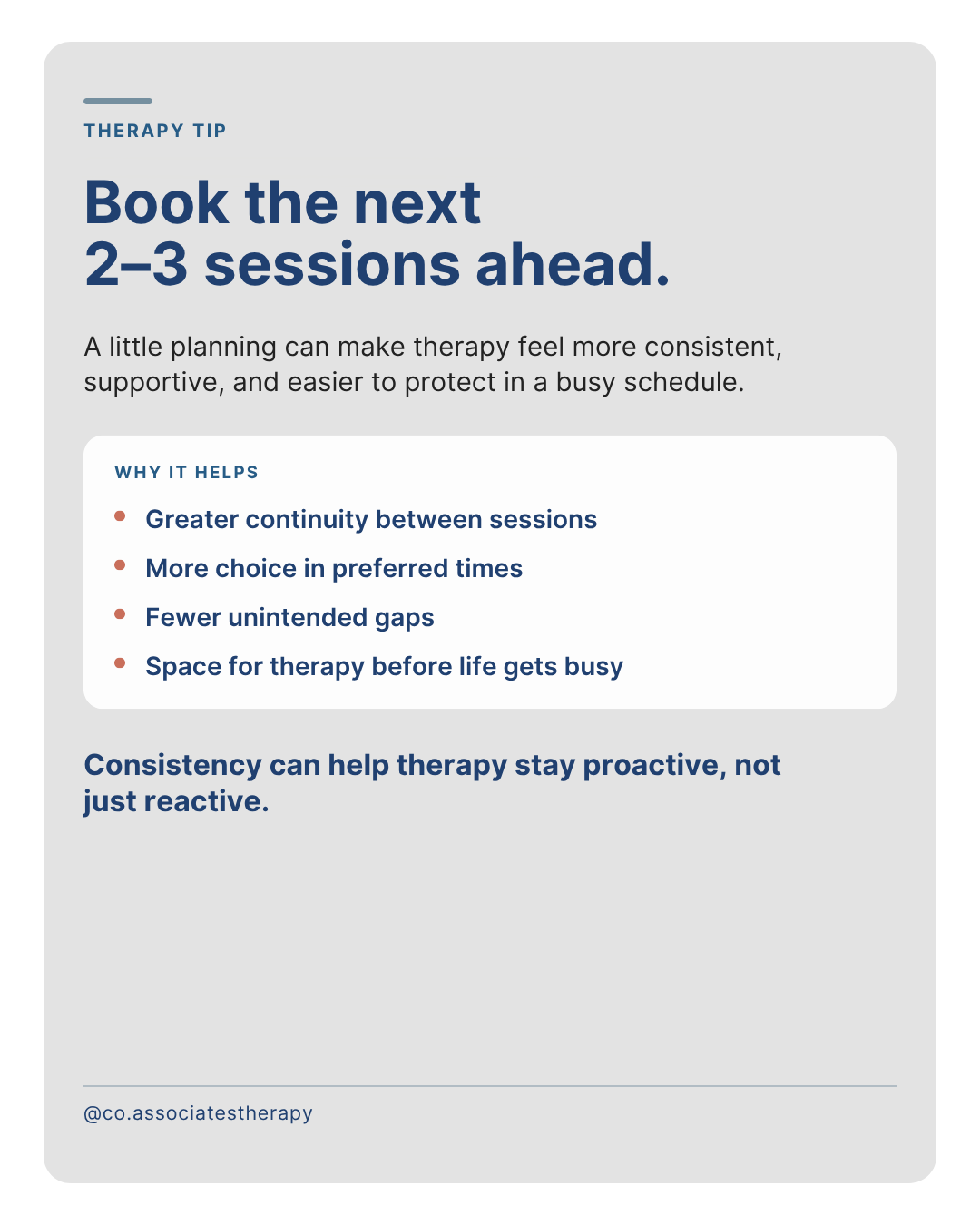
Why Booking Therapy Ahead Can Actually Help Therapy Work Better
One of the things we sometimes encourage clients to do is book a few therapy sessions in advance. And we also understand why people hesitate. Life is busy. Work...
.png)
Meet Mike Finnie: Making Therapy More Accessible at Co & Associates
Meet Mike Finnie, our new Student Therapist offering accessible, compassionate individual support in Milton at a reduced rate of $75 per session.
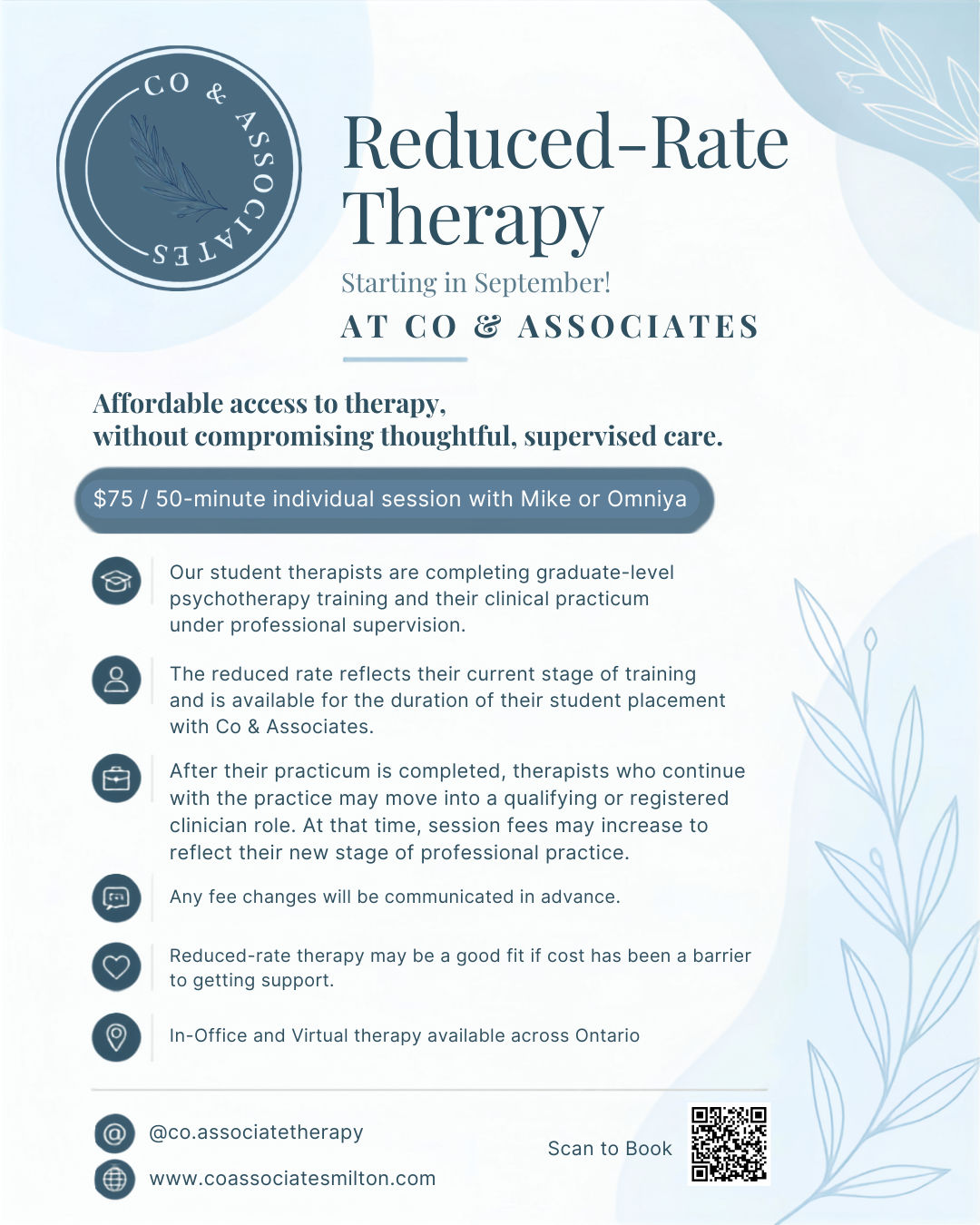
Reduced Rate, Not Reduced Care: Why We Offer Therapy with Student Therapists
Discover why working with our student therapists offers compassionate, high-quality care at an accessible rate without ever compromising on your mental health support.