
 The Collab Journal
By Garion Sparks-Austin, BSW, RSW — Registered Social Worker, Psychotherapist
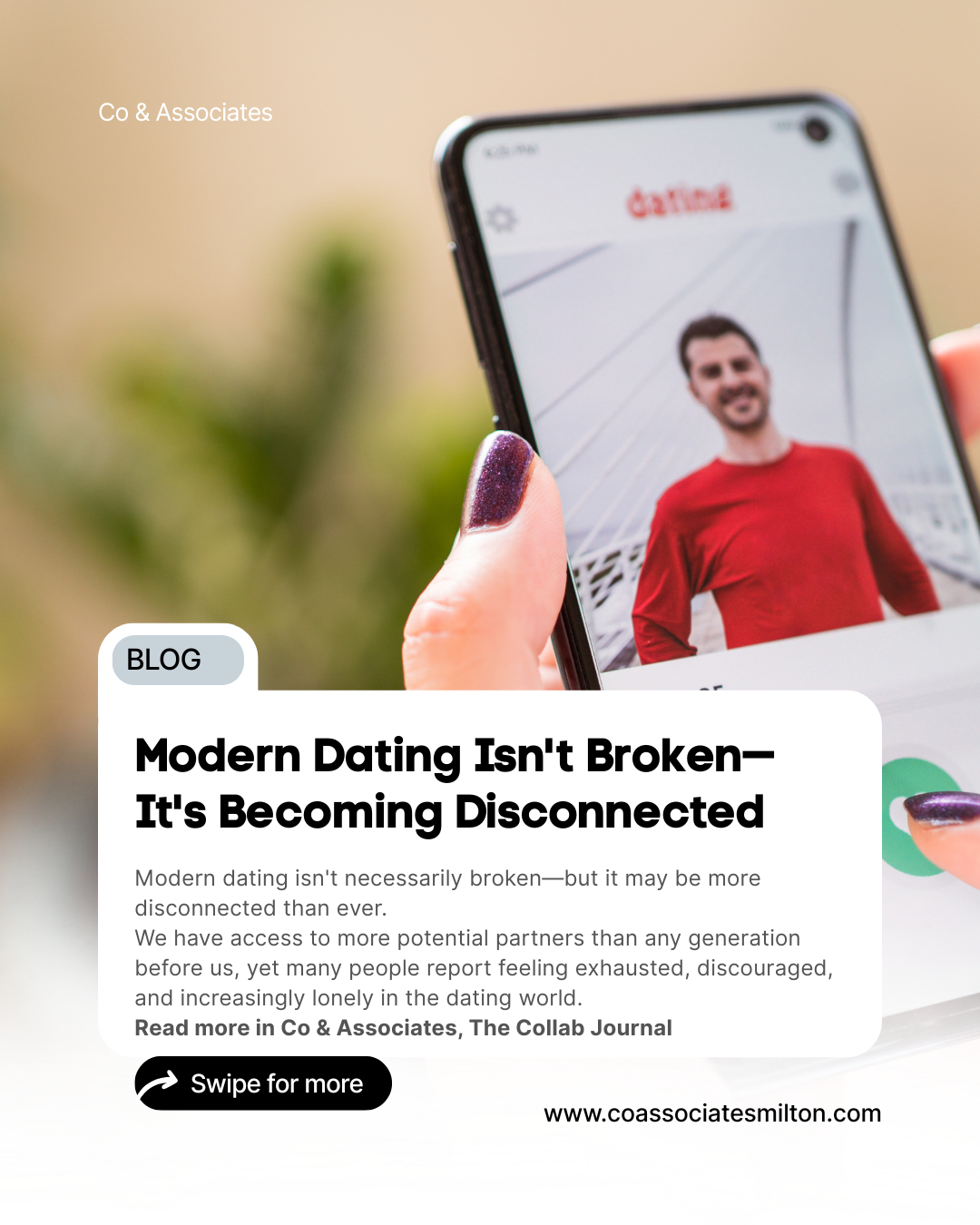
Why finding connection feels harder in an age of endless options...
We have more access to potential romantic partners than any generation before us.
With a few swipes, we can connect with people outside our neighborhoods, social circles, workplaces, and communities. Dating apps promised to make finding love easier, more efficient, and more accessible.
Yet many people report feeling more exhausted, discouraged, and disconnected than ever before.
Why?
The answer may not be that people have become less interested in relationships. It may be that modern dating environments are increasingly structured in ways that make genuine connection harder to cultivate.
The Paradox of Endless Choice
Conventional wisdom suggests that more options should improve our chances of finding a compatible partner.
Psychological research suggests otherwise.
The "paradox of choice" proposes that an abundance of options can actually make decision-making more difficult and leave us feeling less satisfied with the choices we make. Instead of appreciating what is in front of us, we become preoccupied with what else might be available.
Dating apps create the perfect environment for this phenomenon.
When hundreds or thousands of potential matches are available, people can begin approaching relationships with a subtle but persistent question:
"What if someone better is one swipe away?"
This mindset doesn't necessarily make people shallow. It makes them human.
When options appear limitless, commitment can feel riskier because every choice requires closing the door to countless alternatives.
People Become Profiles Instead of People
In real life, attraction develops in layers.
Someone may become attractive because of their humor, warmth, emotional intelligence, confidence, kindness, or the way they make us feel in their presence.
Offline attraction often unfolds over time.
Digital dating compresses that complexity into photos, prompts, job titles, ages, and a few carefully crafted sentences.
Within seconds, people are asked to make decisions about another human being based on highly limited information.
As a result, dating can begin to feel less like meeting people and more like evaluating profiles.
The challenge is not that people are intentionally objectifying one another. The challenge is that the structure of the experience encourages rapid judgment and constant comparison.
Over time, many individuals begin evaluating themselves the same way.
Rather than asking:
"Do I feel connected to this person?"
People may find themselves wondering:
"Am I attractive enough?"
"Am I interesting enough?"
"Why did they stop responding?"
"What is wrong with me?"
The Rise of Dating Fatigue
Researchers have increasingly documented what many singles already know firsthand: dating fatigue.
Studies have identified common experiences including emotional exhaustion, diminished motivation, frustration, cynicism, and burnout associated with prolonged app use. Researchers suggest that practices such as parallel dating, constant evaluation, acceleration of intimacy, and non-commitment can contribute to this fatigue.
For many people, the emotional cycle becomes familiar:
Hope.
Match.
Conversation.
Ghosting.
Disappointment.
Repeat.
The issue is not necessarily rejection itself. Rejection has always existed.
The issue is the frequency, speed, and volume with which people can experience micro-rejections in digital environments.
Over time, dating can begin to feel less exciting and more emotionally draining.
Convenience Has Replaced Community
Historically, many relationships emerged through shared environments:
Friends.
Workplaces.
Neighborhoods.
Faith communities.
Volunteer organizations.
Shared hobbies.
These settings offered something important beyond proximity: accountability.
People were embedded within social networks. How someone treated others mattered because there were social consequences.
Today's dating culture increasingly occurs between strangers who share little social connection.
While this creates opportunities that never previously existed, it also reduces accountability.
Ghosting is easier.
Disappearing is easier.
Treating people as disposable is easier.
This doesn't mean people have become less caring.
It means the environments in which we date often require less responsibility for one another.
The Business Model Nobody Talks About
There is also an uncomfortable reality worth acknowledging.
Dating apps are businesses.
Like most digital platforms, success is often measured by engagement, retention, and continued use.
A platform that users leave forever after finding a partner faces a unique challenge.
This does not mean companies intentionally prevent people from finding love.
Many people do find meaningful relationships through dating apps.
However, there is an inherent tension between helping users leave the platform and encouraging them to continue using it.
The result is an ecosystem that can sometimes prioritize attention, activity, and engagement over slower forms of relationship building.
What Real Connection Requires
The irony is that the qualities most associated with lasting relationships are often difficult to evaluate online.
Emotional safety.
Trust.
Consistency.
Shared values.
Conflict resolution.
Kindness.
Reliability.
These qualities reveal themselves through experiences, not profiles.
Through conversations.
Through observing how someone treats others.
Through spending time together.
Through seeing how they respond when things are inconvenient.
Real intimacy develops in moments that algorithms cannot easily measure.
Getting Back to Human Dating
The solution is not necessarily deleting every dating app.
For many people, dating apps remain a useful tool.
The problem arises when the app becomes the entire dating experience.
Perhaps the invitation is to remember that apps were meant to be introductions, not destinations.
Connection still happens between people, not profiles.
Love still grows through vulnerability, curiosity, consistency, and presence.
And while technology can help us meet, it cannot do the deeper work of helping us connect.
In a culture increasingly built around convenience, perhaps the most radical thing we can do is slow down long enough to truly know another person.
Because the goal was never endless swiping.
The goal was always connection.
This article is intended for educational and informational purposes only. It is not a substitute for therapy, counselling, or individualized mental health care. Everyone's experiences are unique, and support that works for one person may not be right for another. If you're struggling, we encourage you to seek professional support that fits your needs.
Related Articles
Suicide Prevention Awareness Month: Sometimes the Most Important Thing We Can Do Is Ask
Learn how to spot hidden signs of distress, navigate difficult conversations, and support loved ones during Suicide Prevention Awareness Month.

When Starting Over Comes With More Than You Expected: Mental Health, Immigration, Identity & Belonging
Navigating a new chapter comes with hidden grief and complex identity shifts. Discover how therapy can support your journey of belonging.
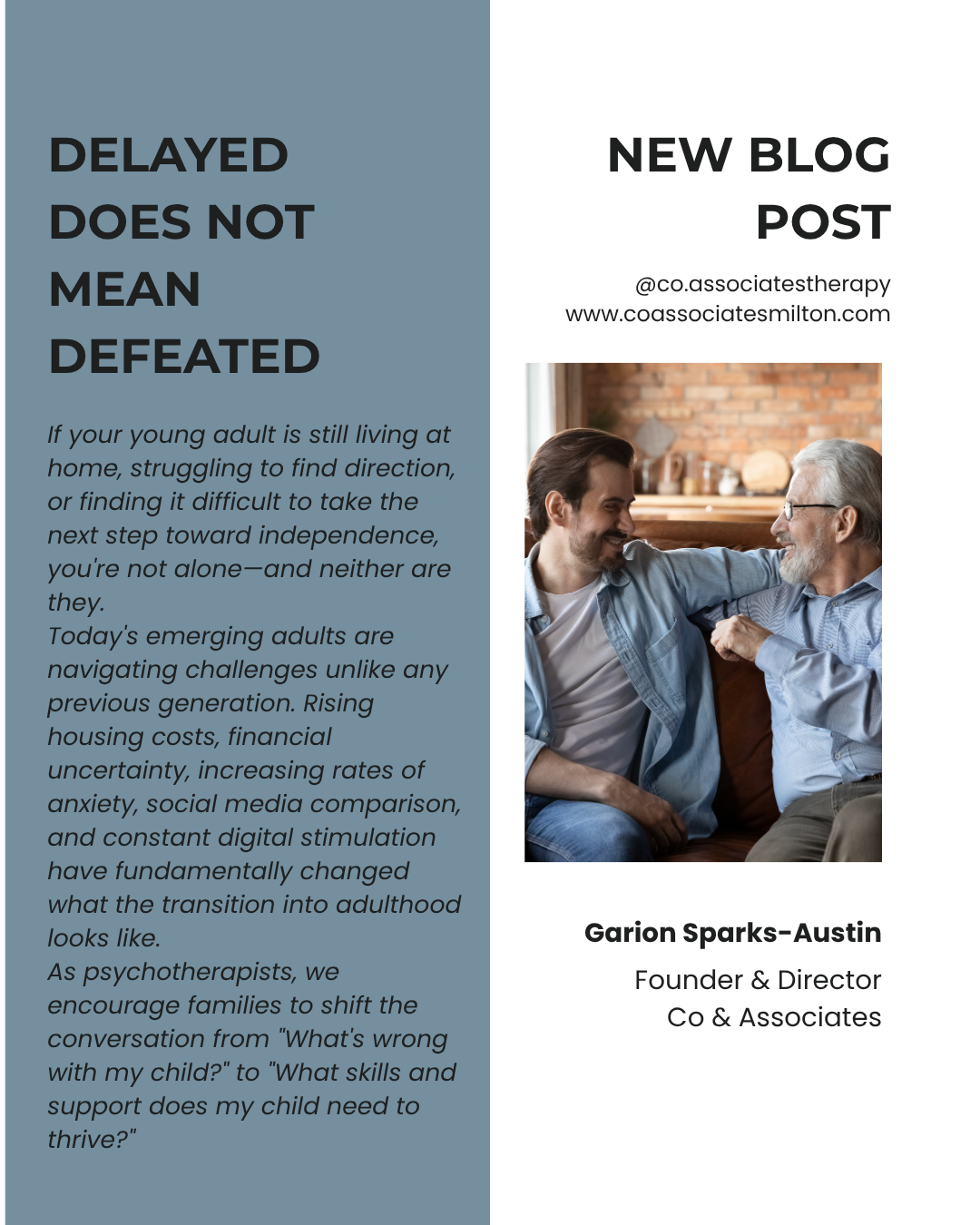
Supporting Your Child When Launching Is Delayed
Is your young adult's launch delayed? Learn how to support their journey to independence with warmth and wisdom, balancing connection with growing autonomy. Discover practical strategies to empower them for a confident future.