
 The Collab Journal
By Garion Sparks-Austin, BSW, RSW — Registered Social Worker, Psychotherapist
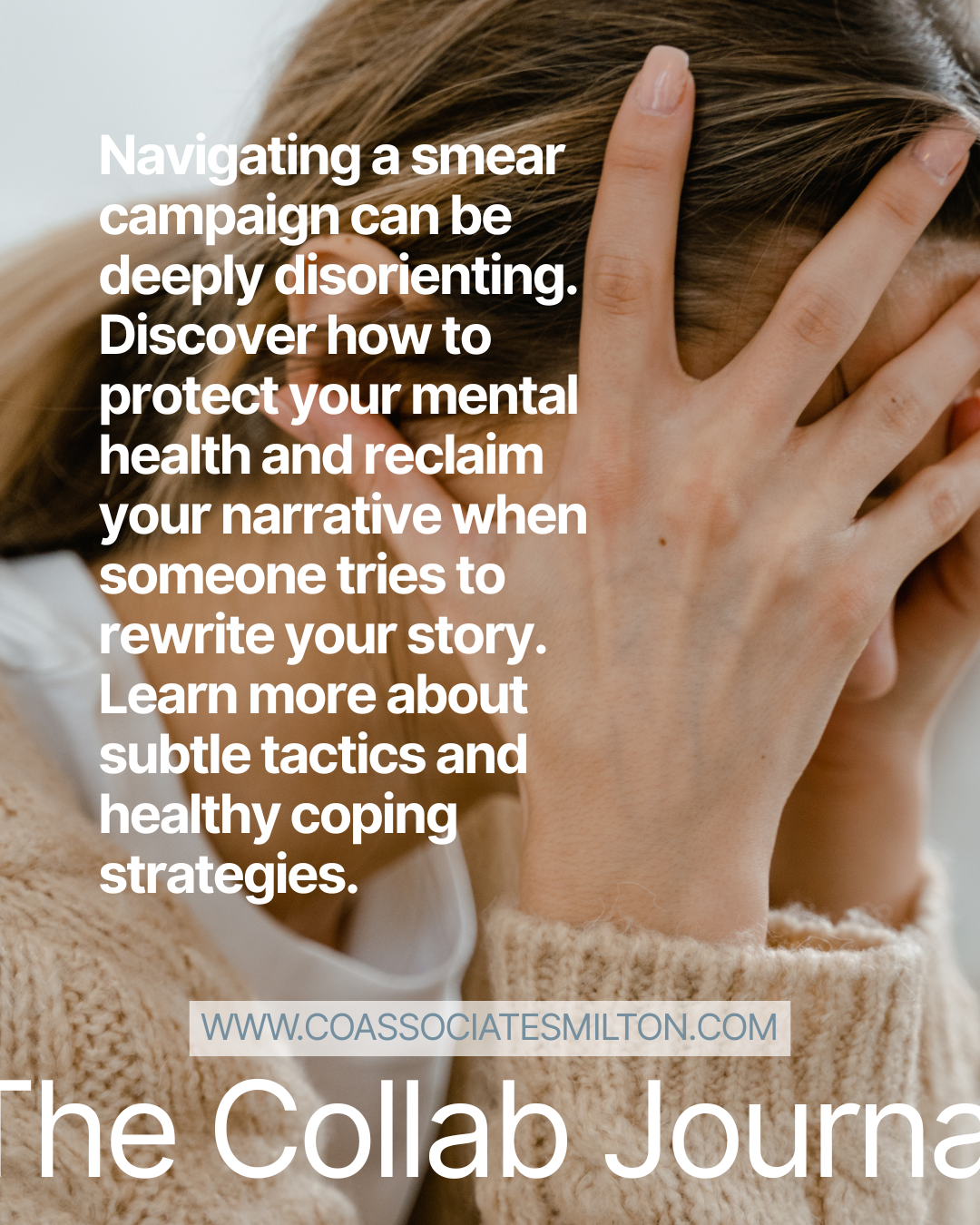
There are few experiences more disorienting than feeling that other people are developing a perception of you that does not reflect your experience of events.
This can happen following the end of a relationship, during family conflict or separation, within friendships, in workplaces, in community settings, or online.
Sometimes people refer to this experience as a “smear campaign.” The term has become increasingly common in conversations about high-conflict relationships and social media. Like many psychological and relational terms, however, it deserves thoughtful use.
Not every disagreement, criticism, conflicting recollection, or negative statement about another person constitutes a smear campaign.
People can experience the same relationship or event very differently. During conflict, emotions, incomplete information, personal perspectives, and different memories can all influence the stories people tell.
What matters is learning how to respond when you believe inaccurate, misleading, or damaging narratives about you are being repeatedly communicated—and how to protect your emotional wellbeing without becoming consumed by the need to defend yourself.
What Do People Mean by a “Smear Campaign”?
The term smear campaign is commonly used to describe a pattern in which misinformation, distortions, selective information, or misleading narratives are repeatedly communicated in ways that damage another person's reputation, credibility, or relationships.
However, intent can be difficult to determine from the outside.
Someone sharing their own perspective, seeking emotional support, expressing anger, or describing a conflict differently from you does not necessarily mean they are deliberately attempting to damage your reputation.
Context matters.
So do accuracy, frequency, behaviour over time, and the impact those communications have on the people involved.
When Conflict Becomes Harmful
Healthy disagreement allows room for different perspectives, accountability, clarification, and ideally some form of resolution.
More concerning patterns can emerge when communication repeatedly involves behaviours such as:
sharing selective information while omitting significant context
presenting speculation as established fact
repeatedly questioning another person's character or credibility without evidence
exaggerating or materially misrepresenting events
involving unnecessary third parties in interpersonal conflict
encouraging others to take sides
repeatedly discussing another person's private affairs beyond what is reasonably necessary
responding to disagreement primarily through escalating personal attacks rather than addressing the underlying issue
Any one of these behaviours occurring once does not necessarily establish a broader pattern.
It is usually more useful to consider behaviour over time rather than trying to determine another person's intentions from a single interaction.
Why These Experiences Can Be So Distressing
Human beings are deeply relational.
Our sense of belonging, connection, and social safety matters. When we believe our reputation, important relationships, or credibility are being threatened, our nervous system may respond with significant stress.
You may notice:
anxiety
difficulty sleeping
racing thoughts
hypervigilance
repeatedly reviewing conversations
fear of being misunderstood
a strong urge to explain yourself
difficulty concentrating
emotional exhaustion
withdrawal from relationships
loss of confidence
For people with previous experiences of relational trauma, bullying, betrayal, emotional abuse, or abandonment, these situations may also activate older emotional wounds.
Understanding this response can help you recognize that the goal is not simply to “win” a disagreement.
It is also to protect your emotional health while deciding what actually requires a response.
Be Careful With Psychological Labels
During high-conflict relationships, people sometimes turn to psychological terminology to make sense of another person's behaviour.
Terms such as narcissist, gaslighter, sociopath, or personality disorder are frequently used online, but these terms can easily become oversimplified or misapplied.
Narcissistic Personality Disorder is a clinical diagnosis requiring comprehensive assessment by an appropriately qualified professional. Narcissistic traits should not be equated with NPD, and difficult, selfish, defensive, manipulative, or hurtful behaviour alone does not establish a personality disorder.
You also do not need to diagnose another person to recognize behaviour that is negatively affecting you.
Often, more useful questions are:
What behaviour am I actually observing?
Is this an isolated incident or a recurring pattern?
What evidence do I have?
How is the behaviour affecting me?
What boundaries are appropriate?
Is there anything I need to document?
What is within my control?
Focusing on observable behaviour rather than diagnostic labels can provide greater clarity while reducing unnecessary stigma.
How to Protect Your Mental Health
1. Stay Grounded in What You Know
When different versions of events are circulating, it can be tempting to continuously revisit every conversation and interaction.
Instead, return to what you can reasonably establish.
Separate:
What happened.
What you believe happened.
What someone else believes happened.
What can actually be demonstrated.
Those categories are not always identical. Being able to tolerate that distinction can be an important part of remaining grounded during conflict.
2. Resist the Urge to Defend Yourself Everywhere
When you believe something inaccurate has been said about you, the natural impulse may be to correct everyone who has heard it.
But constantly defending yourself can become emotionally exhausting.
Before responding, consider:
Does this actually require a response?
There may be circumstances where clarification is important—particularly when children, employment, professional reputation, safety, or legal matters are involved.
In other situations, responding may simply prolong a conflict that cannot be resolved through further explanation. Choose your responses intentionally.
3. Regulate Before Responding
Conflict can activate the body's stress response very quickly.
Before sending an email, text message, social media response, or other communication, create some distance between the emotional reaction and the response.
You might:
take several slow breaths
go for a walk
write what you want to say without immediately sending it
speak with someone you trust
use grounding techniques
wait until the intensity of the initial reaction decreases
Responding thoughtfully rather than reactively protects both your wellbeing and your ability to communicate clearly.
4. Document Facts When Appropriate
If a conflict involves safety concerns, harassment, threats, workplace issues, legal proceedings, or other circumstances where accurate records may become important, maintaining appropriate documentation can be helpful.
Save relevant communications and record significant events factually.
Try to distinguish observations from interpretations.
For example:
Observation: “I received three emails between Monday and Wednesday.”
is different from:
Interpretation: “They emailed repeatedly because they wanted to intimidate me.”
The first describes something that can be established.
The second assigns a motive that may or may not be accurate.
That distinction becomes particularly important when documentation may eventually be reviewed by another professional.
5. Choose Carefully Who Receives Your Story
Not everyone needs to become involved in your conflict.
Consider sharing sensitive experiences with people who can genuinely support you: trusted friends or family, your therapist, legal counsel, or another appropriate professional.
Reducing unnecessary involvement of third parties can sometimes prevent an already difficult situation from becoming even more polarized.
6. Accept What You Cannot Control
One of the hardest parts of interpersonal conflict is accepting that you cannot completely control another person's interpretation of you.
Some people may believe things that you consider inaccurate.
Others may remain uncertain.
And some will form their opinions through their own experiences with you over time.
Trying to manage every person's perception can consume enormous emotional energy.
Your responsibility is ultimately for your own behaviour, values, boundaries, and choices.
When Children Are Involved
Conflict becomes particularly sensitive when parents are separated or co-parenting.
Children should not be asked to carry adult disputes or feel responsible for determining which parent's version of events is correct.
Whenever possible:
avoid criticizing the other parent in front of your child
do not use children as messengers
allow children to maintain their own relationship with each parent when it is safe and appropriate
listen to children's feelings without asking them to choose sides
keep adult legal and financial disputes between adults
document legitimate concerns through appropriate channels
obtain professional or legal guidance when safety concerns arise
There may be situations involving abuse, family violence, substance use, serious mental-health concerns, or other safety issues where additional safeguards are necessary.
In those circumstances, seeking qualified professional and legal guidance can help families determine appropriate next steps.
The child's safety, stability, and emotional wellbeing should remain central.
Healing Beyond Someone Else's Narrative
One of the greatest challenges of feeling misrepresented is learning to stop organizing your life around correcting someone else's version of you.
Healing may involve returning your attention to what remains within your control:
Your values.
Your behaviour.
Your boundaries.
Your emotional regulation.
Your relationships.
Your responsibilities.
Your future.
This does not mean ignoring genuinely harmful behaviour or remaining silent when action is necessary.
It means learning to distinguish between situations that require intervention and situations in which protecting your peace requires disengagement.
When to Seek Professional Support
Ongoing interpersonal conflict can take a significant emotional toll.
Therapy may help you:
process grief, anger, betrayal, or loss
understand your emotional triggers
strengthen boundaries
reduce anxiety and hypervigilance
develop healthier communication strategies
distinguish between what you can and cannot control
respond thoughtfully during high-conflict situations
rebuild confidence and trust in yourself
Professional support can also provide something particularly valuable during conflict: a space where your experience can be explored without requiring another person to be diagnosed, labelled, or vilified.
Final Thoughts
You may never be able to control every version of your story. You may not be able to convince everyone to understand your perspective. What you can control is how you conduct yourself while navigating the conflict.
Stay connected to your values.
Respond thoughtfully.
Document facts when necessary.
Protect appropriate boundaries.
Seek support when you need it.
And remember that protecting your mental health does not require proving that another person is entirely wrong—or that you are entirely right.
Sometimes healing begins when the goal shifts from winning the narrative to living in a way that remains consistent with who you want to be.
If you are navigating emotional abuse, manipulation, high-conflict relationships, or the impact of a smear campaign, the therapists at Co & Associates provide compassionate, trauma-informed, evidence-based counselling for individuals, couples, and families across Ontario.
You deserve relationships built on honesty, respect, safety, and trust. Healing is possible, and you don't have to walk through it alone.
This article is intended for educational and informational purposes only. It is not a substitute for therapy, counselling, or individualized mental health care. Everyone's experiences are unique, and support that works for one person may not be right for another. If you're struggling, we encourage you to seek professional support that fits your needs.
Related Articles
.png)
Finding a therapist who understands your cultural experiences shouldn't mean having to explain every part of your upbringing
Discover culturally attuned therapy in Milton and across Ontario. Connect with our team for compassionate support that truly understands your unique background.
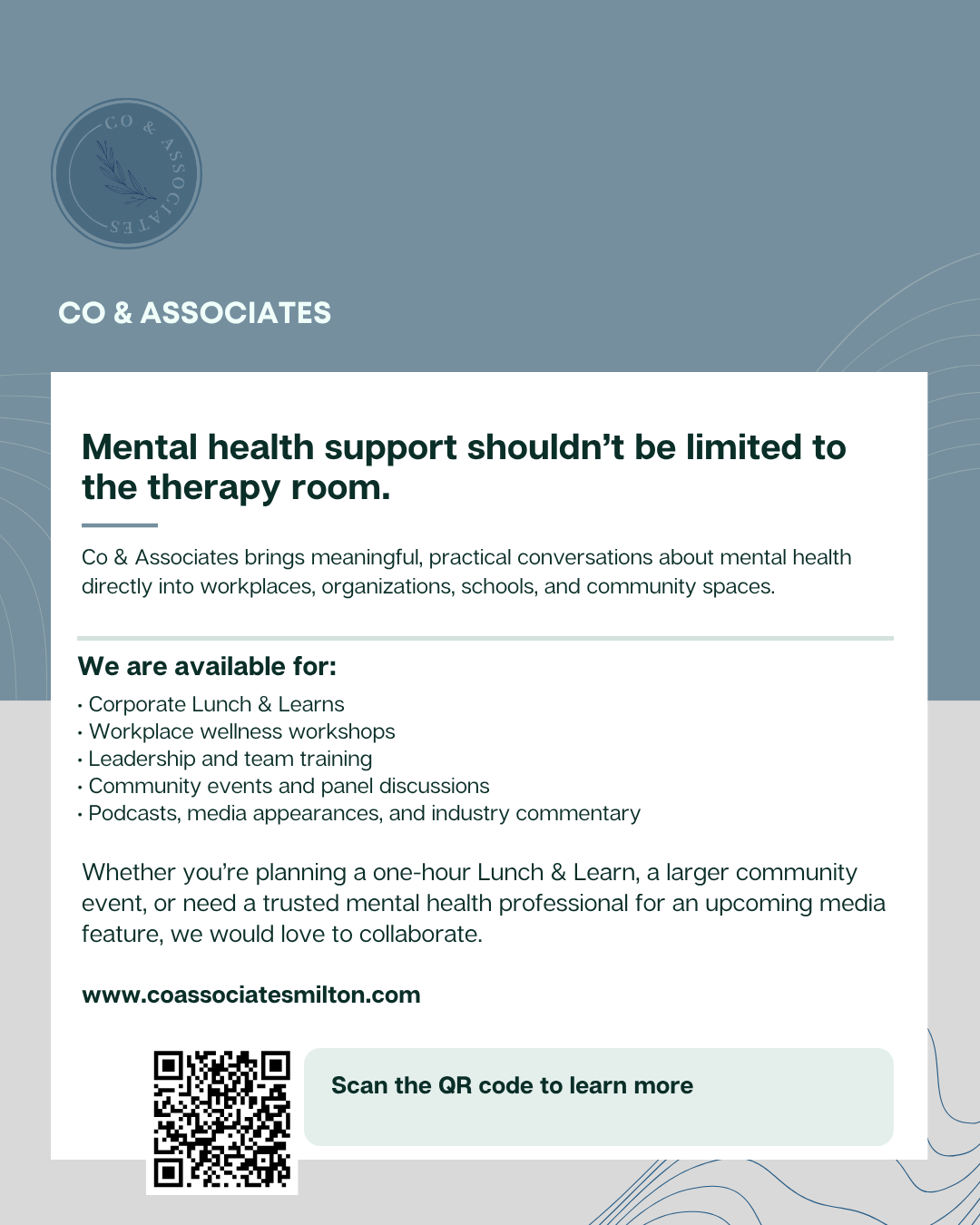
Mental Health Beyond the Therapy Room: Bringing Meaningful Conversations Into the Workplace
Discover how Co & Associates brings practical mental health education and tailored wellness training directly to Milton workplaces to build healthier, more resilient teams.
Suicide Prevention Awareness Month: Sometimes the Most Important Thing We Can Do Is Ask
Learn how to spot hidden signs of distress, navigate difficult conversations, and support loved ones during Suicide Prevention Awareness Month.