
 The Collab Journal
By Garion Sparks-Austin, BSW, RSW — Registered Social Worker, Psychotherapist

You’ve decided you might need support.
You open your laptop.
You type: “therapist near me” or “therapy Ontario.”
And within minutes, you’re flooded with options.
Different titles.
Different approaches.
Different personalities.
And somehow…
more confused than when you started.
If that’s been your experience, it’s not because you’re doing it wrong. It’s because the way most people are told to find a therapist is incomplete.
The Hidden Problem: You’re Being Asked to Choose Without Clarity
Most people start their search focusing on:
Credentials
Modalities (CBT, DBT, EMDR…)
Availability
But here’s the issue:
You’re being asked to make decisions about therapy before you’ve had the space to understand yourself in this context.
So what happens?
You either:
Stay stuck in research mode
Choose someone quickly and hope for the best
Or delay starting altogether
None of these are actually about a lack of motivation. They’re about a lack of clarity.
Why “Just Pick a Therapist” Doesn’t Work
Therapy isn’t like booking a haircut or choosing a gym.
It’s relational.
It’s nuanced.
And it requires a level of alignment that most people aren’t guided to consider.
Because of that, many people end up:
Feeling disconnected in sessions
Unsure if therapy is “working”
Or assuming therapy just isn’t for them
When in reality, the issue isn’t therapy itself. It’s the fit. And fit is rarely accidental.
The Part Most People Skip (But Actually Changes Everything)
There’s a step that often gets overlooked entirely: Slowing down before the search begins.
Not to overanalyze—but to orient. To ask:
What kind of support would actually feel helpful right now?
What tends to shut me down vs. help me open up?
What do I need more of in my life—and what isn’t working anymore?
Without this step, therapy becomes guesswork. With it, everything starts to shift.
Therapy Isn’t One-Size-Fits-All—And That’s a Good Thing
One of the biggest misconceptions is that there’s a single “best” approach to therapy.
There isn’t. Some people need:
Structure and tools
Space to process and reflect
Direct challenge and accountability
Or a slower, safety-first pace
Most people don’t fail therapy. They’ve just never been supported in identifying what actually works for them.
The Cost of Getting This Wrong (That No One Mentions)
When people aren’t guided through this process, they often:
Spend months with the wrong therapist
Feel discouraged or disconnected
Or stop therapy altogether
Not because they didn’t want help—But because the experience didn’t feel aligned. That’s not a small thing. It can shape how someone feels about therapy for years.
What Actually Helps People Move Forward
It’s not more Googling.
It’s not reading endless therapist bios. It’s having a clearer internal reference point before making external choices.
When people feel grounded in:
What they’re navigating
What kind of support resonates
And what matters most in a therapist
They don’t just start therapy—They start it with confidence.
A Different Way to Approach This Process
At Co & Associates, we see this every day. People don’t need more information.
They need:
A way to organize their thoughts
A way to make sense of their needs
A way to move from “I don’t know where to start” → “I feel ready”
That’s the gap most resources don’t address.
If You’re Feeling Stuck, This Is Where to Begin
If you’ve been:
Thinking about therapy but not starting
Overwhelmed by options
Unsure who would actually be a good fit
You’re not alone—and you’re not behind. You’re at the exact point where the process needs to shift.
Not faster.
Not harder.
Just more intentional.
Your Next Step (When You’re Ready)
If you want support in moving from confusion → clarity, we’ve created something designed specifically for this stage.
A guided experience that helps you:
Understand your needs more clearly
Feel more confident in your decisions
And approach therapy in a way that actually aligns with you
You can access it here
Or, if you’d rather talk it through, book a free consultation with our team. Starting therapy isn’t supposed to feel like guessing. And you don’t need to “figure it all out” on your own before beginning. But you do deserve to feel: clearer, more grounded, and more certain about the support you’re choosing.
And that’s something we can help you build—step by step.
This article is intended for educational and informational purposes only. It is not a substitute for therapy, counselling, or individualized mental health care. Everyone's experiences are unique, and support that works for one person may not be right for another. If you're struggling, we encourage you to seek professional support that fits your needs.
Related Articles
.png)
Finding a therapist who understands your cultural experiences shouldn't mean having to explain every part of your upbringing
Discover culturally attuned therapy in Milton and across Ontario. Connect with our team for compassionate support that truly understands your unique background.
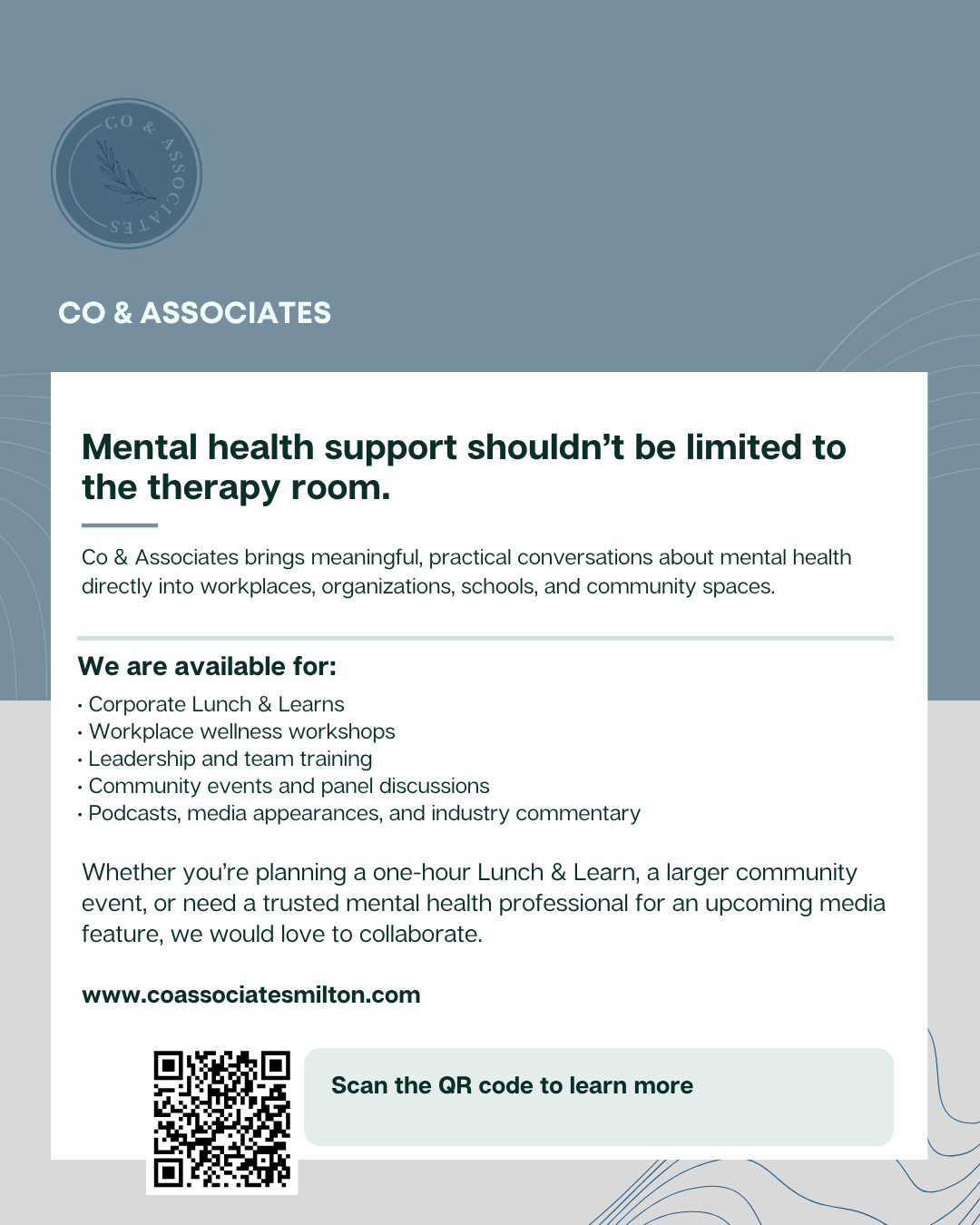
Mental Health Beyond the Therapy Room: Bringing Meaningful Conversations Into the Workplace
Discover how Co & Associates brings practical mental health education and tailored wellness training directly to Milton workplaces to build healthier, more resilient teams.

Suicide Prevention Awareness Month: Sometimes the Most Important Thing We Can Do Is Ask
Learn how to spot hidden signs of distress, navigate difficult conversations, and support loved ones during Suicide Prevention Awareness Month.